Ir para o conteúdo
Back to catalog
PTC Creo
PTC

PTC Creo

PTC Creo 2026 is a parametric 3D CAD/CAM/CAE platform with real-time simulation, generative design, and additive manufacturing.

12.4.4.0 Available windows Verified listing
Access link Open Telegram

Trust signals

Reviewed Link
VIP Support
Activation

Use only trusted sources and check the origin before installing any file. Availability may vary.

About the software

Overview

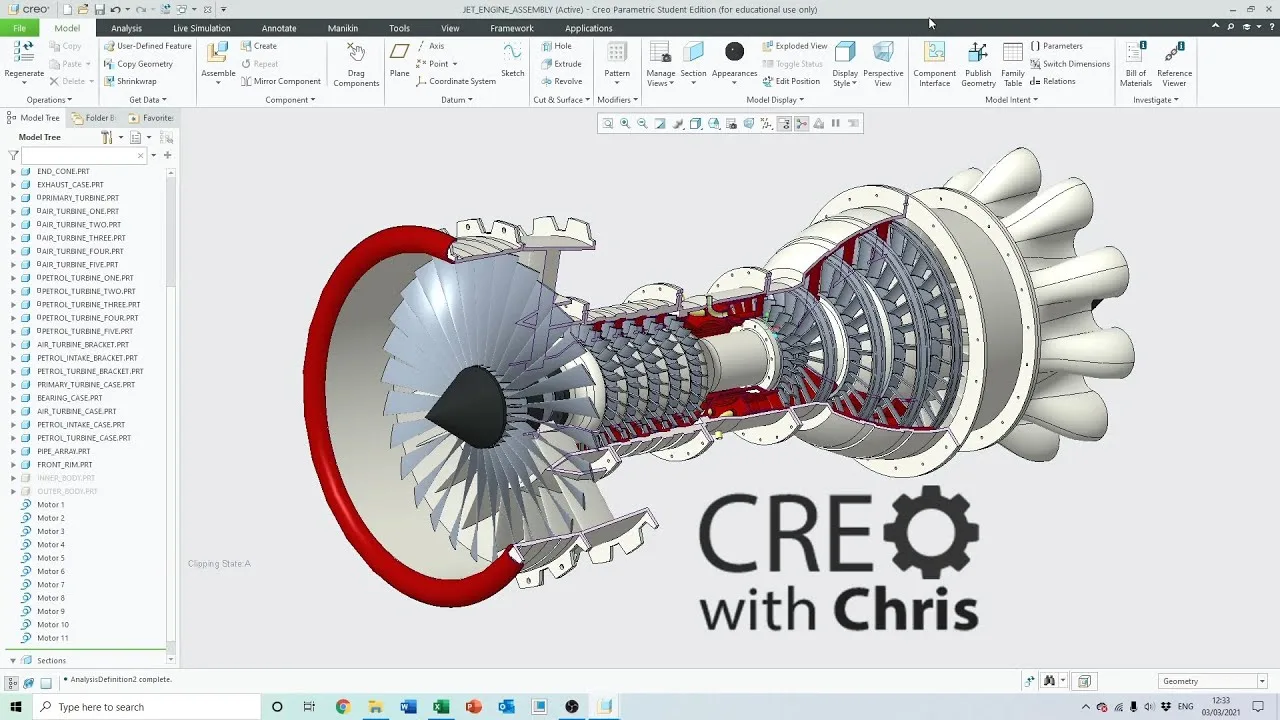
PTC Creo (formerly Pro/ENGINEER) is a powerful parametric 3D CAD/CAM/CAE platform known for robust parametric modeling, large assembly management, and advanced manufacturing capabilities. Used extensively in automotive, aerospace, medical devices, and industrial equipment, Creo combines parametric, direct, and freestyle subdivision surface modeling in a single environment. It was the first commercial CAD software to introduce parametric feature-based modeling and remains a leader in this paradigm.

Creo 2026 introduces Simulation Live - real-time FEA that provides immediate stress, thermal, and modal feedback during the modeling process without leaving the design environment. Generative Design Extension explores optimal material distribution based on loads and constraints. Additive Manufacturing Extension supports lattice generation and 3D print preparation. The CAM capabilities cover 3-to-5-axis milling, turning, and subtractive manufacturing. Windchill PLM integration ensures enterprise-level data management.

Creo is distinguished by its robust parametric foundation, large assembly performance, advanced surfacing with curvature continuity, and AR design review capabilities. It offers a complete suite of extensions that scale from core modeling to specialized analysis, manufacturing, and simulation.

Capabilities

  • Parametric, direct, and freestyle subdivision surface modeling
  • Simulation Live - real-time FEA during design (stress, thermal, modal)
  • Generative design and topology optimization
  • Large assembly management with simplified representations
  • Additive manufacturing with lattice structures and 3D print prep
  • Subtractive CAM (3-to-5-axis milling, turning, multi-tasking)
  • Advanced surfacing with curvature and tangent continuity
  • AR design review with Creo AR Design Share
  • Model-based definition (MBD) and annotations
  • Windchill PLM integration for enterprise data management
  • Piping, cabling, and harness routing
  • Sheet metal and weldment design

Key features

  • 01 Parametric, direct, and freestyle subdivision modeling paradigms
  • 02 Simulation Live real-time FEA feedback during active modeling
  • 03 Generative design with topology optimization and exploration
  • 04 Large assembly management with simplified representations and Shrinkwrap
  • 05 Additive manufacturing with lattice structure generation and optimization
  • 06 Subtractive CAM for 3-to-5-axis CNC machining and turning
  • 07 Advanced surfacing with curvature continuity G3
  • 08 AR design review for real-world scale visualization
  • 09 Model-based definition for paperless manufacturing
  • 10 Windchill PLM integration for enterprise data management
  • 11 Piping, cabling, and electrical harness routing design
  • 12 Sheet metal and weldment design with automatic flat patterns
  • 13 Concurrent design with multi-user collaboration sessions
  • 14 Design exploration with what-if scenario and sensitivity analysis
  • 15 Thermal and fluid flow simulation integration
  • 16 Mechanism dynamics and motion envelope analysis
  • 17 Fatigue and durability prediction simulation
  • 18 Electromagnetic compatibility and thermal management

Benefits

  • 01 Design with real-time FEA simulation feedback during active modeling validate as you create
  • 02 Explore innovative lightweight designs with AI-driven generative design and topology optimization
  • 03 Handle massive assemblies efficiently with simplified representations, Shrinkwrap, and Lightweight mode
  • 04 Produce manufacturable parts directly from design with integrated CAM for 3-to-5-axis machining
  • 05 Review and validate designs in augmented reality at real-world scale before committing to manufacturing
  • 06 Reduce prototype iterations by up to 50% with comprehensive simulation across structural, thermal, and motion domains
  • 07 Capture design intent with flexible modeling paradigms parametric precision or direct modeling speed
  • 08 Bridge the gap between design and manufacturing with model-based definition that eliminates 2D drawings
  • 09 Collaborate on concurrent designs without conflicts using multi-user session technology
  • 10 Customize and automate design workflows with Creo extensive API and customization toolkit

Requirements

  • 01 OS 64-bit Windows 11/10
  • 02 RAM 8 GB minimum (16-32 GB recommended for large assemblies)
  • 03 CPU 3.0+ GHz, Intel Core i7/i9 or AMD Ryzen (high single-core IPC)
  • 04 Disco 20 GB SSD free space
  • 05 GPU 4 GB VRAM, workstation GPU recommended (NVIDIA Quadro/RTX or AMD Radeon Pro)

Frequently asked questions

What is the difference between Creo and Pro/ENGINEER?

Pro/ENGINEER was the predecessor. PTC rebranded the product to Creo in 2011 while maintaining parametric heritage.

What is Simulation Live?

Real-time FEA that provides immediate stress, thermal, and modal feedback during active modeling, without leaving the design workspace.

Does Creo support generative design?

Yes, through the Creo Generative Design Extension for topology optimization and exploration.

Can Creo do CAM?

Yes, Creo includes comprehensive CAM capabilities for 3-to-5-axis milling, turning, and multi-tasking machining.

Gallery

Related software

Verify VIP Public channel Request Catalog