
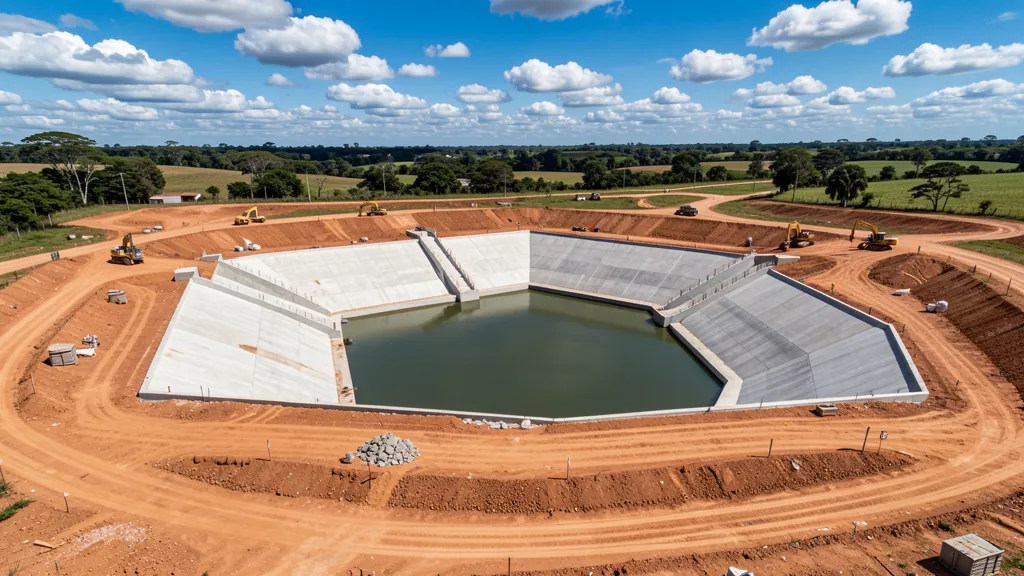
Retention and detention basins are essential structures for controlling urban drainage and preventing floods in urban centers. Designing these systems in AutoCAD Civil 3D with Storm and Sanitary Analysis (SSA) allows for accurate and fast sizing. In this guide, you understand the workflow from geometric modeling to hydraulic validation.
What are retention and detention basins?
Detention basins, known as swimming pools, temporarily store rainwater during heavy rains and gradually release it into the drainage system. Retention basins maintain a permanent volume of water, functioning as buffer lakes that help with water quality and groundwater recharge.
In Brazil, these structures are increasingly required by municipal bodies in new subdivisions and developments. Correct sizing avoids overloading the drainage network and reduces the risk of flooding.
Main types of rainwater control basin:
- Detention basin: Empties after rain event. Dampens the peak of the outlet flow.
- Retention basin: Maintains permanent water level. Provides sedimentation treatment.
- Infiltration basin: Promotes recharge of the water table. No launch system required.
- Inline Basin: Integrated into the drainage system with continuous base flow passage.
Workflow in AutoCAD Civil 3D and SSA
The geometric project begins with the definition of the land surface and the contribution area. Using the digital terrain model (MDT), the river basin is delimited and the volume necessary to buffer rainwater is calculated.
Storm and Sanitary Analysis is Autodesk's tool for hydrological and hydraulic analysis of drainage systems. The recommended workflow includes:
- Settings: Define units, hydrological method (SCS or Rational) and return time according to NBR 10844.
- StorageNode: Represent the basin as in the storage basin with the Civil 3D dimension x area x volume curve.
- Connections: Define arrival conduits, overflow spillways, orifices and release structures.
- Validation: Run simulation and check overflows in the network and basin.
- Fit: Modify parameters and repeat the analysis until the desired performance is achieved.
The integration between Civil 3D and SSA exports the geometry directly, eliminating rework and ensuring consistency between the geometric and hydraulic model.
Practical tips for sizing
The sizing of a detention basin depends on multiple variables: drainage area, runoff coefficient, return time, duration of critical rainfall and requirements of the supervisory body. In Brazil, the most common payback times vary from 10 to 100 years depending on the criticality of the work.
The elevation x area x volume curve is the most critical data for the SSA and must be extracted from the Civil 3D model using comparative surfaces between natural terrain and excavated design. THE AutoCAD Civil 3D in the CanalVIP catalog offers all the tools for these drainage and earthmoving analyses.
Points of attention in the project:
- Consider the worst rain scenario for the region using local historical series.
- Check the municipality's requirements regarding the maximum release flow into the public network.
- Include emergency storm spillways above the project.
- Document all hydrological premises for approval by competent bodies.
How to get AutoCAD Civil 3D
AutoCAD Civil 3D is the standard platform for infrastructure projects in Brazil. With it, you can model the terrain, design detention and retention basins and carry out complete hydrological analyses. Check out the options in the CanalVIP catalog and speed up your urban drainage projects. Access the CanalVIP catalog.