
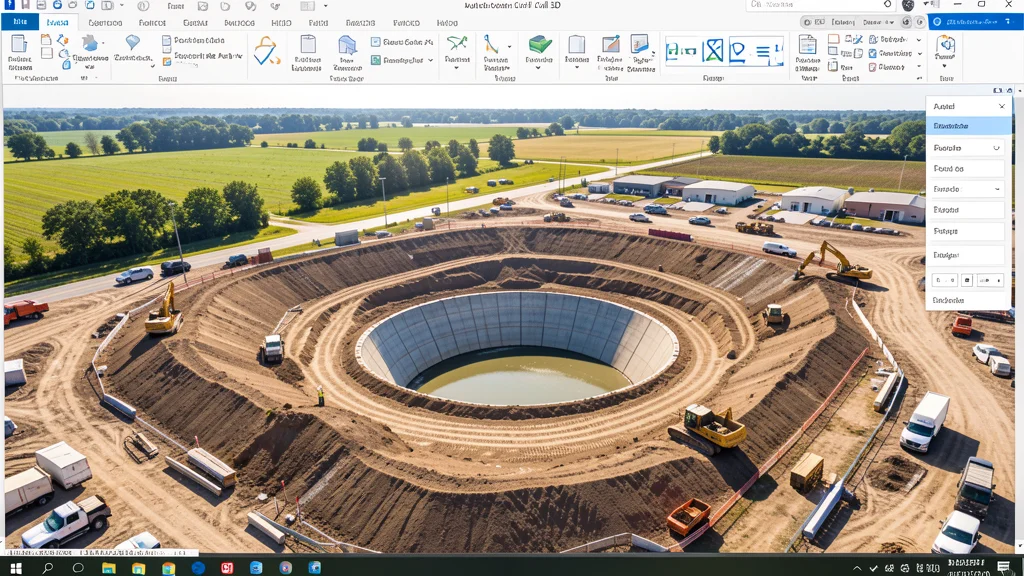
Offline detention basin design in AutoCAD Civil 3D 2023 is a mandatory step in urban drainage and infrastructure works. In this technical guide, you will find the complete step-by-step guide to designing, modeling and sizing detention basins using Civil 3D tools, with real hydrological parameters and integration with Brazilian standards.
Offline Detention Basins: Technical Concepts
Detention basins are reservoirs designed to temporarily store surface runoff during heavy rain events. They release water gradually, reducing peak flow downstream and preventing flooding. The term "offline" indicates that the basin remains dry between rain events — water only enters through diversion structures when the capacity of the main system is exceeded.
Retention basins, on the other hand, maintain a permanent volume of water and function as reservoirs with landscaping and water treatment benefits. Both typologies are regulated by Brazilian technical standards and require detailed hydrological design for correct sizing.
- Offline Detention: dry between rains, controlled release by orifice, suitable for dense urban areas and subdivisions
- Retention: permanent volume, improves water quality, ideal for parks and green areas
- Offline advantages: lower maintenance, no vector proliferation, shallower excavation at high water table
- Common Applications: mining, highways, industrial districts, logistics terminal and urban flood control
Geometric Modeling in Civil 3D 2023
AutoCAD Civil 3D 2023 offers a robust set of tools for modeling detention basins. The flow begins with the creation of the natural terrain surface from topographic points or dimensioned contour lines. With the base surface defined, the contour of the basin is projected respecting the limits of the available area, land use and environmental restrictions.
3D modeling of the basin involves defining cut and fill slopes with inclinations determined by the geotechnical project. Civil 3D automatically calculates earthwork volumes, generating earth movement reports that are essential for the work budget. The complete method includes the design of the bypass structure, the approach channel and the energy sink at the exit.
The training developed by CSR Engenharia & Consultoria, available in the Autodesk Community gallery, demonstrates the complete process with BIM modeling and 4D planning of construction evolution, integrating the disciplines of earthmoving, drainage and paving in a single environment.
Hydrological Dimensioning and Applicable Standards
The correct sizing of the offline detention basin depends on hydrological studies that determine the peak flow for different return periods, generally adopting TR=25 years for microdrainage and TR=100 years for macrodrainage. The storage volume is calculated by the difference between the influent hydrograph and the effluent flow controlled by a restriction device, such as orifices or spillways.
The main technical standards applicable to the project in Brazil include:
Civil 3D 2023 allows you to simulate scenarios with different precipitation intensities, return periods and runoff coefficients, automatically generating quota-area-volume curves. This integration between hydrology and modeling reduces errors and speeds up project reviews during the environmental licensing phases.
How to Get AutoCAD Civil 3D 2023
Companies and professionals who want to implement these techniques need access to appropriate software and technical training. AutoCAD Civil 3D 2023 is available on CanalVIP catalog with full versions and specialized support. Invest in your team and raise the quality of your infrastructure projects with the most advanced tools on the market.