
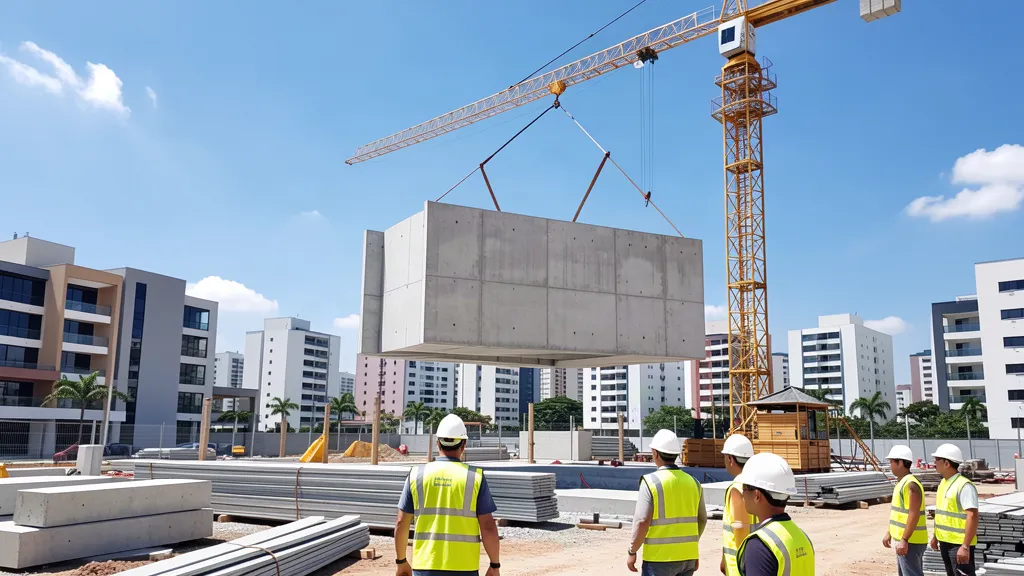
Industrialized construction advances in Rio Grande do Sul with a strategic partnership between Sinduscon-RS and UFRGS. The extension course "Characteristics, performance and execution of industrialized construction systems" brought together engineers, architects and companies in the sector to discuss methods that increase productivity and face the shortage of labor in Brazilian construction.
The Sinduscon-RS and UFRGS course on industrialized systems
The inaugural class was held at the union's headquarters and opened by Roberto Sukster, vice-president and coordinator of the Materials, Technology, Quality, Productivity and Sustainability Commission (COMAT+S). According to him, the topic is essential for civil construction in Brazil and, in particular, in Rio Grande do Sul: "The course will be very important to expand the technical knowledge of the participating companies and professionals."
Rubem Piccoli, director of Sinduscon-RS and coordinator of the Technological Transfer and Training Forum, recalled that the 2026 edition marks the sixth extension course promoted by the Forum, with more than 200 qualified people. The training also includes professors Denise Carpena Coitinho Dal Molin and Ângela Borges Masuero, from the Postgraduate Program in Civil Engineering (PPGCI/UFRGS), and Maria Angélica Covelo Silva, from NGI Consultoria.
The first class was taught by Luiz Henrique Ceotto, a civil engineer with more than 40 years of experience, a master's degree in Structural Engineering from USP and holder of an executive certificate from MIT. Ceotto led construction areas at Tishman Speyer and Encol and has built more than 800 buildings under his guidance, bringing practical examples of large-scale industrialization.
Why industrialization is strategic for the sector
The diagnosis presented in the course is clear: Brazilian construction needs to resolve historical bottlenecks such as the shortage of qualified labor and low productivity rates. Industrialization appears as the most direct way to overcome these obstacles, transferring part of the work from the construction site to factories and standardized processes, with measurable gains at all stages of the work.
Ceotto highlighted that, despite the high interest rate, the time is favorable to discuss innovation. According to him, the tax reform should cause a major transformation in the sector's production processes, making industrialization even more relevant for the future of construction in the country.
- Productivity — industrialized systems reduce steps and execution times on site.
- Quality — parts produced in a controlled environment have standards and traceability.
- Deadlines — less dependence on weather conditions and intensive labor.
- Waste — planned cutting and assembly reduces material losses.
- Safety — critical activities migrate from the construction site to industrial processes.
What changes in the project and the work
For engineers and architects, industrialized construction requires a change in mentality from the design stage. Systems such as steel frame, wood frame, precast concrete panels and light steel frame depend on detailed modeling, compatibility of disciplines and precise planning — exactly the field where BIM shows its value. Designing to industrialize means thinking about modules, connections and assembly sequences before the work even begins.
Tools such as Revit, AutoCAD and Civil 3D are widely used to model and document these systems, generating integrated plans, quantities and schedules. Professionals who master this flow come out ahead in a market that is moving towards more industrialized and digitalized processes. To update your work environment with these tools, check out the CanalVIP catalog with the main design and modeling solutions.
How to track the movement
The partnership between Sinduscon-RS and UFRGS shows that technical qualification is the engine of transformation. Courses, forums and initiatives such as the Technology Transfer and Training Forum create the bridge between university and market that the sector needs. For engineers and architects, the message is straightforward: whoever masters design, BIM and industrialized construction systems will be prepared for the next phase of Brazilian civil construction. Keep up with industry news and keep your tools up to date on CanalVIP software portal.